Dog With Persistent Nasal Bleeding — Veterinary Endoscopy Revealed a Hidden Nasal Tumor
Chronic nasal bleeding in dogs is often mistaken for simple rhinitis or infection. However, persistent unilateral nosebleeds may indicate serious underlying diseases, including nasal tumors, foreign bodies, fungal infections, or severe inflammatory lesions.
This case demonstrates how veterinary endoscopy enabled direct visualization of a hidden nasal lesion that could not be accurately evaluated through routine examination alone.
Case Background
- Species: Dog
- Gender: Male
Chief Complaint
- Recurrent unilateral nasal bleeding
- Frequent sneezing
- Mild breathing difficulty
- Reduced appetite
The symptoms had persisted for several weeks despite routine symptomatic treatment.
Clinical Challenge
Nasal diseases are difficult to diagnose because:
- ▪️The nasal cavity is narrow and deep
- ▪️Routine examination provides limited visibility
- ▪️X-ray imaging may miss early lesions
- ▪️Blind treatment often delays accurate diagnosis
Possible differential diagnoses included:
- ▪️Nasal foreign body
- ▪️Severe rhinitis
- ▪️Fungal infection
- ▪️Nasal polyp
- ▪️Nasal tumor
▪️Direct visualization was required for accurate diagnosis.
Endoscopic Nasal Examination
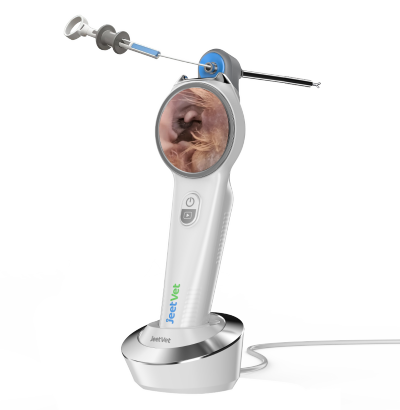
The veterinary team performed rhinoscopy using the JeetVet RAE-109 portable veterinary endoscope.
- ▪️General anesthesia administered
- ▪️Endoscope inserted through the nasal cavity
- ▪️Continuous insufflation for improved visualization
- ▪️Sequential examination of the nasal passage
- ▪️Identification of abnormal proliferative tissue
Key Findings
- Irregular proliferative tissue observed inside the nasal cavity
- Localized bleeding and mucosal inflammation
- Partial airway obstruction
The lesion was highly suspicious for a nasal tumor.
Biopsy samples were collected under direct visualization for pathological analysis.
Why Veterinary Endoscopy Was Critical
1. Direct Visualization
The endoscope enabled clear observation of:
- Tumor margins
- Bleeding points
- Mucosal condition
This significantly improved diagnostic accuracy.
2. Minimally Invasive Diagnosis
Traditional exploratory surgery was avoided.
- Reduced patient trauma
- Lower complication risk
- Faster postoperative recovery
3. Accurate Biopsy Collection
Under endoscopic guidance, tissue samples were collected precisely from abnormal regions, improving pathology reliability.
Veterinary Rhinoscopy vs Traditional Examination
| Comparison | Veterinary Endoscopy | Traditional Examination |
|---|---|---|
| Visualization | Direct high-definition visualization | Limited external observation |
| Diagnostic Accuracy | High | Often inconclusive |
| Biopsy Capability | Precise targeted biopsy | Difficult or blind sampling |
| Trauma | Minimally invasive | May require surgical exploration |
| Recovery | Fast | Longer recovery time |
How JeetVet Endoscope Helped
The JeetVet RAE-109 portable veterinary endoscope provided several advantages during the procedure:
- ▪️Slim insertion tube for narrow nasal passages
- ▪️High-definition imaging for lesion identification
- ▪️Flexible maneuverability inside complex anatomy
- ▪️Portable connection to phone and computer
- ▪️Working channel for biopsy and treatment instruments
Especially suitable for:
- ▪️Rhinoscopy
- ▪️Nasal foreign body removal
- ▪️Biopsy procedures
- ▪️Upper respiratory examination
Treatment Outcome
- Nasal bleeding significantly improved
- Breathing became more stable
- Earlier treatment planning became possible
- Recovery monitoring was continued
Early endoscopic diagnosis allowed faster clinical intervention and improved prognosis.
Clinical Value of Veterinary Endoscopy
Compared with traditional methods, veterinary endoscopy offers:
- ▪️Earlier diagnosis
- ▪️More accurate lesion localization
- ▪️Better treatment planning
- ▪️Reduced patient trauma
Minimally invasive respiratory endoscopy significantly improves veterinary diagnostic capability and clinical efficiency.
Conclusion
Persistent nasal bleeding in dogs should never be ignored.
Veterinary endoscopy provides a safe and highly effective method for diagnosing hidden nasal diseases, enabling:
- ▪️Accurate visualization
- ▪️Precise biopsy collection
- ▪️Minimally invasive intervention
- ▪️Faster clinical decision-making
Modern veterinary rhinoscopy is becoming an essential tool for advanced respiratory diagnostics in companion animals.