Veterinary Endoscope for Bronchoscopy: A Practical Guide to Respiratory Examination in Dogs and Cats
Persistent coughing, abnormal breathing sounds, unexplained respiratory signs, and suspected airway disease are common reasons for veterinary respiratory investigation.
Physical examination and diagnostic imaging can provide important information, but some respiratory conditions may require direct visualization of accessible airway structures. In selected patients, a veterinary endoscope can help veterinarians examine the respiratory tract and collect additional diagnostic information.
Veterinary bronchoscopy is an endoscopic technique used to visually examine portions of the lower respiratory tract. Depending on the patient and clinical indication, endoscopy may also support sampling procedures such as airway lavage or targeted collection of diagnostic material.
This guide explains when bronchoscopy may be considered, what veterinarians can evaluate, and which veterinary endoscope features matter for respiratory applications in dogs and cats.
What Is Veterinary Bronchoscopy?
Bronchoscopy is an endoscopic procedure that allows a veterinarian to directly visualize accessible portions of the airway using an appropriately selected endoscope.
A flexible veterinary endoscope can be advanced through an appropriate route so the veterinarian can inspect respiratory structures under direct visualization.
Depending on the patient, equipment, and procedure, the examination may provide information about:
- Airway mucosal appearance
- Visible secretions
- Airway narrowing or obstruction
- Visible inflammatory changes
- Foreign material
- Abnormal tissue or lesions
- Other visible structural abnormalities
Bronchoscopy should not be viewed as an isolated diagnostic answer. Endoscopic findings are interpreted together with the patient's history, physical examination, imaging, laboratory results, and other appropriate tests.
When Might a Dog or Cat Need Respiratory Endoscopy?
Respiratory signs can have many different causes, so the presence of one symptom does not automatically mean that bronchoscopy is required.
A veterinarian may consider veterinary respiratory endoscopy when further investigation of the airway is clinically appropriate.
Possible situations include:
- Persistent or recurrent coughing
- Unexplained respiratory signs
- Abnormal respiratory sounds
- Suspected airway obstruction
- Possible inhaled foreign material
- Persistent respiratory abnormalities despite initial evaluation
- Need for airway sampling
- Visible abnormalities requiring closer examination
The decision to perform bronchoscopy depends on the individual patient's condition and the veterinarian's clinical judgment.
Why Direct Airway Visualization Matters
Respiratory diagnostic methods provide different types of information.
Imaging techniques can help veterinarians evaluate patterns and structures that are not visible externally. Endoscopy adds another perspective by allowing direct observation of accessible internal airway surfaces.
During bronchoscopy, the veterinarian can evaluate visible characteristics such as:
- Color and appearance of airway mucosa
- Quantity and character of visible secretions
- Airway shape and symmetry
- Areas of apparent narrowing
- Visible foreign material
- Localized abnormal tissue
This visual information may help guide subsequent diagnostic decisions, but it must be interpreted within the complete clinical picture.
Veterinary Bronchoscopy for Persistent Coughing
Persistent coughing is one clinical sign that may lead to a more detailed respiratory investigation.
However, coughing is not a diagnosis. It can be associated with multiple respiratory and non-respiratory conditions.
If initial evaluation does not fully explain the problem, a veterinarian may consider bronchoscopy in dogs or cats to directly examine accessible airway structures.
Endoscopic findings can then be combined with other diagnostic information to support a more complete assessment.
Can a Veterinary Endoscope Detect Airway Foreign Bodies?
Foreign material can occasionally enter the respiratory tract. Depending on its size, location, material, and the patient's condition, an airway foreign body may be difficult to characterize through external examination alone.
A veterinary endoscope may allow direct visualization of accessible foreign material within the airway.
In selected cases, compatible instruments passed through a working channel may also support endoscopic manipulation or retrieval.
However, not every airway foreign body is suitable for endoscopic removal. Location, shape, tissue involvement, patient stability, and procedural risk must all be considered by the veterinary team.
Bronchoscopy and Airway Sampling
One important advantage of respiratory endoscopy is that visualization and sampling may be combined during the same diagnostic procedure when clinically appropriate.
Depending on the equipment and examination protocol, a veterinarian may collect material from the respiratory tract for further laboratory evaluation.
Sampling can be useful because visual appearance alone may not determine the underlying cause of an airway abnormality.
For example, areas that appear inflamed during endoscopy may require additional testing before the veterinarian can determine the nature of the underlying process.
What Is Bronchoalveolar Lavage?
Bronchoalveolar lavage, often abbreviated as BAL, is a respiratory sampling technique used in veterinary medicine.
In general terms, sterile fluid is introduced into an appropriate portion of the respiratory tract and then recovered so that the collected sample can be evaluated.
Depending on the clinical situation and technique, respiratory endoscopy may help support visualization and sampling during the diagnostic process.
The collected material may then be submitted for appropriate laboratory analysis as determined by the veterinarian.
BAL is not required for every respiratory patient. Whether it is appropriate depends on the suspected disease, patient condition, and diagnostic objectives.
Flexible Veterinary Endoscope for Respiratory Examination
A flexible veterinary endoscope can be particularly useful when the examination requires navigation through curved respiratory anatomy.
Important characteristics include:
- Appropriate insertion tube diameter
- Sufficient working length
- Clear image quality
- Adequate illumination
- Responsive distal tip control
- An appropriate working channel when sampling or instruments are required
These specifications should be evaluated together rather than independently.
Why Insertion Tube Diameter Matters in Bronchoscopy
Dogs and cats vary substantially in body size and airway dimensions.
For respiratory examination, the insertion tube needs to be appropriate for the individual patient and intended anatomical pathway.
A smaller diameter may support access in smaller patients, but diameter should not be evaluated alone. Clinics must also consider whether the endoscope provides the required imaging capability, working length, and working channel.
| Feature | Why It Matters for Respiratory Endoscopy |
|---|---|
| Insertion Tube Diameter | Needs to be appropriate for patient size and the intended airway pathway. |
| Working Length | Provides the required reach for the intended examination. |
| Image Quality | Supports visualization of airway surfaces and visible abnormalities. |
| Tip Control | Helps navigate and direct the field of view. |
| Working Channel | May support compatible instruments or sampling procedures. |
The Importance of Image Quality in Veterinary Bronchoscopy
Respiratory structures can contain subtle visual differences, making image quality an important part of endoscopic assessment.
Useful visualization depends on more than resolution alone.
Veterinarians should also consider:
- Illumination quality
- Color reproduction
- Image stability
- Field of view
- Working distance
- Clarity in the presence of secretions
A well-balanced imaging system can help the veterinarian maintain a useful view while navigating the airway.
Why a Working Channel Can Be Important
A working channel extends the function of a veterinary endoscope beyond visualization alone.
Depending on the system and procedure, the channel may support compatible instruments or fluid-related functions required for selected diagnostic techniques.
For respiratory applications, this may be relevant for:
- Airway sampling
- Selected foreign body retrieval
- Compatible biopsy instruments when clinically appropriate
- Other procedure-specific accessories
The required working channel size should be evaluated together with insertion tube diameter and instrument compatibility.
Portable Veterinary Endoscopy for Respiratory Practice
A portable veterinary endoscope may offer practical advantages for clinics that need to move equipment between examination rooms or use endoscopy across different clinical environments.
When evaluating portability, clinics should consider more than device size.
A practical system should balance:
- Ease of setup
- Image quality
- Insertion tube configuration
- Working channel capability
- Image or video documentation
- Cleaning and reprocessing requirements
The goal is to select a system that fits the clinic's actual respiratory endoscopy workflow.
Bronchoscopy Should Be Part of a Complete Respiratory Workup
Veterinary bronchoscopy can provide valuable visual and sampling information, but it is usually only one component of respiratory diagnosis.
Depending on the patient, a complete investigation may include:
- Medical history
- Physical examination
- Thoracic imaging
- Laboratory testing
- Airway endoscopy
- Respiratory sampling
- Additional tests based on clinical findings
The appropriate diagnostic pathway should be determined for each individual patient.
How JeetVet Supports Veterinary Respiratory Endoscopy
JeetVet develops veterinary endoscope solutions designed for different animal sizes and clinical applications.
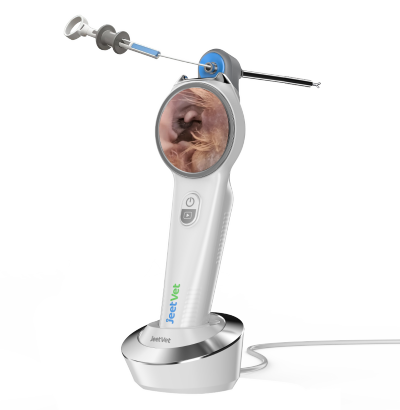
For respiratory applications, the RAE-105 Portable USB Veterinary Endoscope can support respiratory endoscopy and lung lavage applications. Its configuration includes a 1000 mm working length, HD imaging, water and air supply capability, and a forceps working channel.
For clinics evaluating respiratory endoscopy equipment, the appropriate system should be selected according to patient size, anatomical access, required working length, insertion tube configuration, imaging needs, and any sampling or instrument requirements.
No single endoscope configuration is ideal for every dog, cat, or respiratory procedure. Matching the equipment to the intended clinical application remains the most important consideration.
How to Choose a Veterinary Endoscope for Bronchoscopy
Before selecting respiratory endoscopy equipment, veterinary clinics can consider the following questions:
- Will the system primarily be used for dogs, cats, or both?
- What patient sizes are most common in the clinic?
- Which parts of the respiratory tract are intended to be examined?
- What insertion tube diameter is appropriate?
- Is airway sampling required?
- Is a working channel necessary?
- Which compatible instruments or accessories will be used?
- Is portability important to the clinical workflow?
- How will images and videos be documented?
- What cleaning and reprocessing procedures are required?
Conclusion
Veterinary bronchoscopy provides veterinarians with direct visualization of accessible respiratory structures and can support further diagnostic investigation in selected dogs and cats.
For patients with persistent coughing, abnormal respiratory signs, suspected airway abnormalities, or a need for respiratory sampling, a veterinary endoscope may form an important part of the diagnostic workup when clinically appropriate.
The value of respiratory endoscopy depends not only on visualization but also on choosing equipment suited to the patient and procedure. Insertion tube diameter, working length, image quality, maneuverability, working channel design, and instrument compatibility should all be considered together.
By selecting an appropriate flexible veterinary endoscope and integrating bronchoscopy with other diagnostic methods, veterinary teams can obtain a more complete view of respiratory health in dogs and cats.